
A Civilization With Deep Roots
Myanmar's history stretches back thousands of years. Long before any foreign power arrived, the region was home to thriving civilizations — the Pyu, the Mon, the Bamar, and dozens of other peoples — each with their own traditions, governments, and cultures. These were not primitive societies. They built cities, traded internationally, created literature and art, and established legal systems centuries before European contact.
The most famous of Myanmar's early periods is the Bagan Empire, which flourished between the 9th and 13th centuries. At its height, Bagan was the capital of a powerful kingdom, and its rulers built more than 10,000 temples and pagodas across a wide plain on the banks of the Irrawaddy River. The site was recognized by UNESCO as a World Heritage Site in 2019, with more than 2,200 structures still standing at that time. Tragically, a powerful 7.7-magnitude earthquake struck central Myanmar in March 2025, causing significant damage to many of Bagan's ancient temples and pagodas. UNESCO has been working to assess the full extent of the losses. The grandeur of Bagan is not just a tourist landmark — it is a reminder that the Burmese people have a long and sophisticated history that predates every colonial border drawn on a map.
Buddhism arrived in Myanmar over a thousand years ago and became woven into the fabric of daily life, architecture, government, and culture. The monastery system became the center of education. The values of compassion, community, and generosity that travelers encounter in Myanmar today have roots that go very deep.
"Bagan at sunrise, with thousands of temple spires rising from the morning mist, is one of the most extraordinary sights in the world. It is also one of the most overlooked — much like the people who built it."— Travel writers and scholars who have visited Myanmar
Britain Takes Control: 1824–1885
Myanmar's encounter with European colonialism came gradually, then completely. Britain fought three wars against Burma across the 19th century — in 1824, 1852, and 1885 — each one expanding its territorial control. After the third war, which lasted only a matter of weeks, the British captured Mandalay, dethroned the last Burmese king, and absorbed the entire country into the British Empire as a province of India.
British rule reshaped Myanmar in profound ways. The colonial economy extracted Burma's rich natural resources — teak, rice, oil, and precious gems — primarily for British benefit. Indian workers were brought in large numbers to fill administrative and labor roles, displacing Burmese workers and creating lasting ethnic and economic tensions. Traditional Burmese institutions — the monarchy, the village systems, the networks of local authority — were dismantled or undermined.
At the same time, British rule brought new schools, a railway system, and access to international ideas. It was in this era that Burmese students began reading about democracy, self-determination, and independence — and began organizing to achieve it. The University of Rangoon (later Yangon) became a hotbed of political thought, and student movements launched nationwide strikes against British rule in 1920, 1936, and 1938. The independence movement was not handed to Myanmar. It was built by a generation of determined young people who refused to accept colonial rule as permanent.
Who Was Aung San?
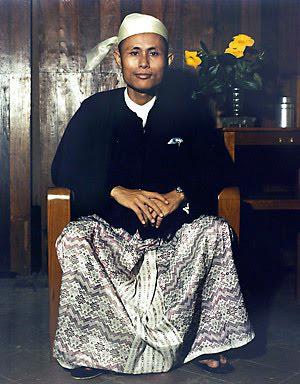
Aung San is the founding father of modern Myanmar — its George Washington. A student activist turned military leader, he negotiated Burma's independence from Britain and forged a fragile unity agreement among Burma's many ethnic groups known as the Panglong Agreement (1947). He was assassinated just months before independence was declared, at age 32.
His daughter, Aung San Suu Kyi, would go on to lead Myanmar's democracy movement decades later — carrying her father's name and his unfinished work into a new generation.
Freedom, Then Fragility: 1948–1962
On January 4, 1948, Burma became an independent nation. The celebrations were real, but so was the fragility. The country was immediately torn by ethnic tensions, communist uprisings, and the difficulty of governing a diverse nation that had been forced together under colonial rule and was now suddenly on its own.
The democratic government of U Nu — a deeply devout Buddhist and skilled politician — worked to hold the country together through the 1950s. These years were imperfect but genuine: Burma had a free press, competitive elections, a lively civil society, and real political debate. It was also during this period that the University of Rangoon shone as one of the finest academic institutions in Southeast Asia, attracting students from across the region.
The ethnic conflicts, however, never fully resolved. Different groups — the Karen, the Kachin, the Shan, and others — had fought alongside the British during World War II and had been promised various forms of autonomy and rights. Many felt those promises were not being kept. Armed resistance movements grew in the hills. The central government struggled to respond. The fragile peace of independence was always under pressure.
The Military Takes OverNe Win and the Long Night: 1962–1988
On March 2, 1962, General Ne Win and the Burmese military staged a coup and took power. They arrested elected leaders, closed the parliament, and ended Burma's democratic experiment. It was supposed to be temporary. It lasted for decades.
Ne Win imposed a system he called the "Burmese Way to Socialism" — a blend of nationalism, economic isolation, and authoritarian control that was difficult to understand and disastrous in practice. Burma closed itself off from the world. Foreign businesses were nationalized. International aid was rejected. The free press was shut down. The thriving economy of the 1950s collapsed. By the 1980s, Burma — which had once been one of the most prosperous nations in Southeast Asia — was applying to the United Nations for Least Developed Country status.
Throughout this period, the military ruled through fear. Dissent was suppressed. Ethnic minority communities in the hills faced ongoing military campaigns. The universities, once centers of learning and debate, were gutted. The country that had celebrated independence in 1948 with such hope had, by the 1980s, been isolated, impoverished, and silenced.
And yet — the people endured. They found ways to maintain community, to pass down culture, to keep faith alive. The monastery tradition continued. The warmth for which Myanmar is known did not disappear under military rule. It went underground, and waited.
The Democracy MovementThe 8888 Uprising: A Generation Rises
In 1988, something remarkable happened. Ne Win's government demonetized the currency — wiping out people's life savings overnight, reportedly based on astrological advice. People had had enough. Students, monks, teachers, dockworkers, and ordinary families flooded the streets of Rangoon and cities across the country. The protests became known as the 8888 Uprising, for the date of a major strike: August 8, 1988.
It was during these protests that a woman named Aung San Suu Kyi stepped forward. She was the daughter of independence hero Aung San, returning to Burma to care for her ill mother. She had not intended to enter politics. But when she saw what was happening, she could not stay silent. On August 26, 1988, she stood before a crowd of half a million people outside the Shwedagon Pagoda and called for democracy. The crowd was electrified. A movement was born.
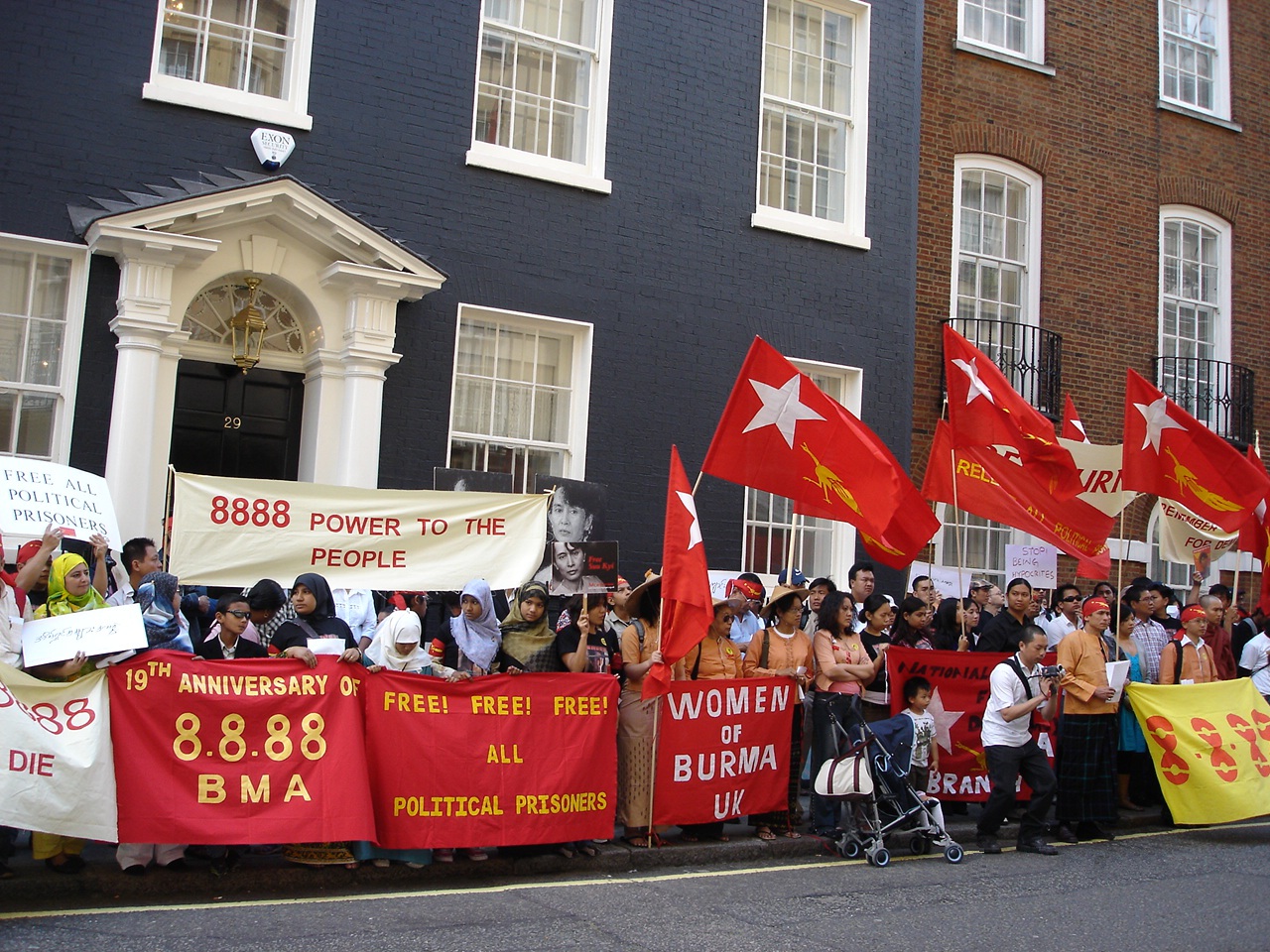
The military's response was brutal. Soldiers opened fire on protesters. At least 3,000 people were killed. Thousands more were arrested or fled the country. A new military junta, calling itself the SLORC (State Law and Order Restoration Council), took formal control. They renamed the country Myanmar and the capital Yangon — but the regime's character did not change.
"It is not power that corrupts, but fear. Fear of losing power corrupts those who wield it, and fear of the scourge of power corrupts those who are subject to it."— Aung San Suu Kyi, from her essay "Freedom from Fear" (1990)
A Stolen Victory: 1990–2010
In 1990, under international pressure, the military held elections. Aung San Suu Kyi's National League for Democracy (NLD) won by a landslide — capturing more than 80% of the parliamentary seats. The military refused to honor the results. Suu Kyi was placed under house arrest, where she would spend a total of more than 15 years over the following two decades. In 1991, while still under house arrest, she was awarded the Nobel Peace Prize. She could not travel to receive it.
The world watched, issued statements, and largely moved on. Myanmar remained isolated and controlled. In 2007, Buddhist monks led peaceful protests in what became known as the Saffron Revolution — thousands of monks marching in red-orange robes, calling for an end to military rule. The military cracked down again. The monks were arrested, the protests dispersed.

Throughout these years, the Christian communities in Myanmar's ethnic minority regions — the Kachin, the Chin, the Karen — continued to face particular pressure. They were doubly vulnerable: both as ethnic minorities and as followers of a faith the military associated with foreign influence. And yet the churches grew. The faith deepened. The community held.
What Was Life Like During These Decades?
For ordinary families in Myanmar, these decades meant growing up without reliable electricity, without a free press, without the ability to speak openly about politics. Parents taught children to be careful about what they said at school. Traveling required permits. Foreigners were rare. The internet did not arrive until the late 2000s — and even then, it was monitored and restricted.
And yet people celebrated weddings, raised children, attended their temples and churches, shared meals, and found joy in each other. Life under authoritarianism is not only suffering. It is also ordinary human love persisting against extraordinary pressure.
The Democratic Experiment: 2010–2020
Beginning around 2010, the military began to loosen its grip — cautiously, and on its own terms. Aung San Suu Kyi was released from house arrest. International sanctions began to ease. Foreign investment arrived. The internet spread. For the first time in decades, Myanmar's people had access to news, to social media, to the wider world. It felt like a sunrise.
In 2015, the NLD won a historic election — the first free and fair election in twenty-five years. Aung San Suu Kyi could not become president under a constitution the military had written to prevent it (it barred anyone with foreign-born children from the presidency). But she became State Counsellor, effectively the leader of the civilian government. The world celebrated. Investors arrived. Tourism boomed.
It was an imperfect transition. The military retained significant power, including reserved seats in parliament and control of key ministries. The ethnic conflicts in the hills continued. The treatment of the Rohingya Muslim minority led to international condemnation. But for the Burmese people who had lived through sixty years of military rule, the years from 2015 to 2020 were still something remarkable: an imperfect, fragile, but real experiment in democracy.
In November 2020, the NLD won again — by an even larger margin. The people had spoken, clearly, for the second time in five years.
"For a brief, extraordinary window, Myanmar was opening. Young people were starting businesses. Journalists were reporting freely. Families were dreaming of a different future. And then, on the morning of February 1, 2021, it ended."— Strategic Global Missions
The Thread That Runs Through It All
Understanding this history helps make sense of why February 1, 2021 hit Myanmar's people so hard. This was not just a political reversal. It was a return to something they thought they had finally left behind — a repeat of the pattern their parents and grandparents had lived through. The grief was not just about the present. It was about all of it: the decades of lost dreams, the cost paid in lives and freedoms, the slow and painful progress that was suddenly gone.
But the thread that runs through all of this history is something else: the persistence of the Burmese people. They have been colonized, isolated, impoverished, silenced, and betrayed — and they have never stopped reaching for something better. That is not nothing. That is, in fact, extraordinary. And it is the context for everything that is happening in Myanmar today.